
Imagine you are cruising along the M50 when you notice that nagging low pressure warning light on your dashboard. It is the third time this month you have had to top up the air, and the anxiety of a potential blowout is starting to overshadow your morning commute. You know it is a slow puncture, but the thought of wasting hours in a busy Dublin tyre centre is enough to make anyone procrastinate. It is a stressful dilemma; do you risk the motorway journey or sacrifice your valuable time for a repair that might not even be possible?
We understand that your safety and your schedule are equally important. This guide is designed to help you identify the signs of a failing tyre and manage the situation before it becomes a roadside emergency. You will learn exactly how to secure a professional slow puncture repair Dublin motorists can trust, allowing you to get back on the road from the comfort of your home or office. We will explore the official RSA safety standards, the difference between temporary plugs and permanent fixes, and the specific signs that indicate whether your tyre can be saved or requires a full replacement.
Key Takeaways
- Spot the subtle warning signs of pressure loss, such as recurring TPMS alerts, before a minor leak becomes a dangerous roadside emergency.
- Learn the professional safety criteria for a permanent fix, including why only the central “Minor Repair Zone” of the tread is suitable for repair.
- Save time and protect your tyre’s structure by booking a professional slow puncture repair Dublin experts can perform at your home or workplace.
- Understand the legal and mechanical risks of ignoring low pressure, from internal sidewall degradation to potential penalty points and NCT failure.
- Discover why a mobile on-site inspection is the most effective way to save a repairable tyre and avoid the unnecessary cost of a full replacement.
Understanding Slow Punctures: Why Dublin Roads are Tough on Tyres
A slow puncture is often described as a “ghost” mechanical issue. Unlike a sudden blowout that demands immediate attention, a slow puncture is a gradual decrease in tyre pressure, typically losing just a few pounds per square inch (PSI) over several days or weeks. This “invisible” nature makes it particularly dangerous. You might not notice the change in handling until you are taking a sharp corner or braking suddenly on a wet Dublin evening. Because the deflation is so subtle, many drivers assume their tyres are simply reacting to the cold Irish weather, rather than a physical breach in the rubber.
Dublin motorists face a unique set of challenges. Constant redevelopment in areas like the Docklands and various city centre roadworks means our streets are often littered with industrial debris. Small nails, screws, and even heavy-duty staples are easily picked up by a warm, pliable tyre. While premium tyres often have denser rubber compounds that can sometimes “seal” around a small object, budget tyres may degrade faster once the carcass is breached. If your vehicle uses run-flat tire technology, the symptoms of a slow leak can be even harder to detect. The reinforced sidewalls mask the initial drop in pressure, making regular checks vital. Seeking a slow puncture repair Dublin expert ensures that these hidden threats are identified before they compromise your safety.
Common Causes of Gradual Pressure Loss
Understanding the source of the leak is the first step toward a permanent resolution. Most gradual air loss stems from three specific areas:
- Roadworks debris: Sharp metal fragments from construction sites are the primary culprit for tread penetrations.
- Corroded wheel rims: Over time, moisture and road salt cause the inner rim to corrode. This prevents the tyre bead from forming an airtight seal, leading to “bead leaks.”
- Perishing tyre valves: Rubber valves can crack and become brittle as they age. They often leak air whilst the wheel is spinning and under load, even if they seem fine when the car is parked.
The Role of Dublin Potholes in Tyre Fatigue
Potholes don’t just cause immediate bursts; they often create “pinch shocks.” This occurs when the tyre is compressed against the rim, damaging the inner liner without leaving a visible mark on the outside. This internal bruising leads to a slow, steady escape of air that can be difficult to diagnose without professional equipment. Impacts can also cause hairline cracks in alloy wheels. Even a microscopic fracture allows air to seep out, making it feel like a tyre issue when the wheel itself is the problem.
If you are commuting on the M50, the high speeds generate significant heat within the tyre. This heat increases the internal pressure and causes the rubber to expand, which often accelerates the rate of air loss from an existing penetration. It is a cycle of degradation that only ends in a flat tyre or, worse, a structural failure at speed. Professional slow puncture repair Dublin services can inspect both the tyre and the rim to ensure the root cause is addressed, rather than just treating the symptom.
Spotting the Warning Signs Before a Blowout Occurs
Detection doesn’t always happen whilst you are cruising at speed. In fact, the most reliable way to spot a leak is the “cold start” check before you begin your morning commute. When the rubber is cold and the air inside hasn’t expanded from friction, the true pressure is revealed. If one tyre looks slightly more compressed than the others, or if the sidewall seems to “belly” out more than usual, you are likely dealing with a slow leak. Identifying these subtle changes early can be the difference between a simple fix and a dangerous roadside failure.
Your hands on the steering wheel provide some of the best diagnostic data available. A tyre with low PSI often feels heavy or “mushy” during low-speed manoeuvres. You might notice the car drifting slightly towards the kerb or the centre line when you relax your grip on a straight stretch of road. This “pulling” is a classic symptom of uneven pressure across an axle. If you’re unsure whether that drifting sensation is a wheel alignment issue or a leak, it’s best to have an expert perform a slow puncture repair Dublin wide to rule out a failing tyre.
Interpreting Your TPMS Dashboard Alerts
Your Tyre Pressure Monitoring System (TPMS) is your first line of defence, but it requires correct interpretation. In our unpredictable Irish climate, it is common for a light to trigger on a frosty morning and then vanish once the tyres warm up. This happens because air contracts in the cold. However, if that light returns the next day, it isn’t just the weather. It is a sign that the pressure has dropped below the safety threshold. A system fault often flashes or stays amber regardless of pressure, whereas a genuine low-pressure warning is a steady, persistent alert that demands an inspection.
Visual and Physical Symptoms of a Leak
Get close to the tyre with a torch and look for shiny metal heads embedded in the rubber. Screws and nails often wedge themselves deep amongst the tread blocks, creating a seal that allows only a tiny amount of air to escape. You might even hear a rhythmic “ticking” sound that increases in frequency as you accelerate. Pay close attention to the sidewalls. If you see any bulging or “bubbling,” the internal structure is already compromised. At this stage, following the professional criteria for puncture repair is essential. These standards help determine if the tyre can be safely patched or if the damage has reached a point where the tyre is no longer roadworthy.
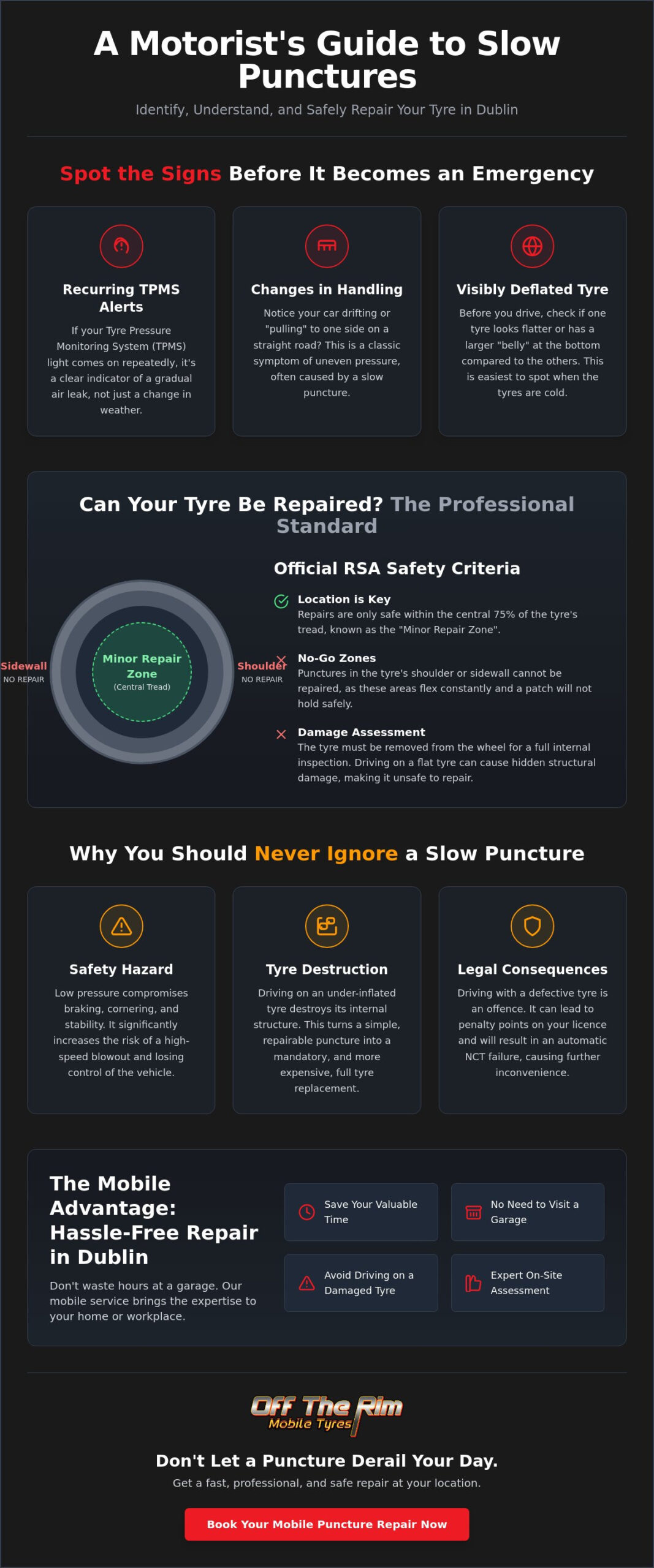
Why You Should Never Ignore a Slow Puncture
Many drivers fall into a dangerous routine of “topping up” their air every few days at a petrol station. This might feel like a cost-effective way to manage the problem, but it is a short-term gamble with high stakes. Driving on a tyre that is even slightly underinflated causes the sidewalls to flex excessively. This friction generates intense heat, which rapidly degrades the rubber’s internal structure. It is an invisible process that compromises the tyre’s ability to hold its shape under load. Eventually, the bond between the rubber and the internal cords weakens, leading to a catastrophic failure.
Beyond the structural risk, there is a financial penalty to procrastination. Low pressure increases the rolling resistance of your vehicle, meaning your engine has to work harder to maintain speed. This directly impacts your fuel economy and leads to uneven tread wear, shortening the lifespan of your tyre. For expert advice on tire safety and maintenance, industry experts emphasise that consistent pressure is the most critical factor in preventing premature failure and ensuring your vehicle handles as the manufacturer intended.
The Hidden Damage of “Run-Flat” Driving
When a tyre is driven whilst underinflated, the internal liner can begin to disintegrate. This creates a fine rubber powder, often called “marbling,” inside the tyre carcass. Once this structural damage occurs, the tyre is no longer repairable. What could have been a straightforward, affordable fix becomes an expensive necessity for a full replacement. If you are questioning is my tyre safe to drive on, the answer is almost always “no” if you have been ignoring a leak for more than a few days. Prompt slow puncture repair Dublin wide ensures you save the tyre before the internal walls collapse completely.
Safety Risks for You and Other Road Users
The safety implications are particularly severe in the wet and unpredictable Dublin weather. Underinflated tyres have a smaller, distorted contact patch with the road, which significantly reduces braking efficiency. This can add several metres to your stopping distance during an emergency. Navigating the M50 off-ramps or busy city roundabouts becomes a hazard, as the compromised sidewall cannot provide the lateral stability required for safe cornering. The vehicle may feel “floaty” or unresponsive, especially during sudden evasive manoeuvres.
There is also the legal reality to consider. In Ireland, driving with defective or worn tyres is a serious offence. According to the Road Safety Authority (RSA), you can face a fine of €80 and up to four penalty points upon conviction. If your tyre is losing air, it is likely already operating below safe limits and could fail an NCT inspection. Arranging a slow puncture repair Dublin service isn’t just about convenience; it is about remaining road-legal and protecting everyone on the road from the threat of a sudden, high-speed blowout. If you are travelling beyond the city and a tyre emergency strikes on a rural route, knowing how to access emergency roadside tyre help Wicklow drivers can rely on is equally important for your safety.
Can It Be Fixed? The Professional Criteria for Puncture Repair
Not every breach in a tyre’s surface is a candidate for a patch. Professional technicians in Ireland adhere to the BSAU159 safety standard, which dictates exactly when a repair is safe and when it is a liability. The most critical factor is the location of the damage. For a slow puncture repair Dublin drivers can rely on, the penetration must fall within the “Minor Repair Zone.” This is the central 60 to 70 per cent of the tyre’s tread width. Anything outside this area is considered too close to the sidewall to be safely handled.
The size of the puncture also dictates the outcome. Standard passenger car tyres can usually be repaired if the hole is no larger than 6mm in diameter. If you have picked up a large bolt or a jagged piece of metal, the structural damage is likely too extensive for a patch to hold. Safety is the priority; we never compromise the integrity of your vehicle for the sake of a quick fix. If the damage meets these criteria, a professional repair is a cost-effective way to extend the life of your tyre.
Location Matters: Tread vs Sidewall
The sidewall and the shoulder of a tyre are high-flex areas. Every time the wheel rotates, these sections bend to absorb the weight of the car and the contours of the road. A plug or patch in this zone will eventually work itself loose due to this constant movement, leading to a sudden deflation. We also check the proximity of the damage to any existing fixes. If two punctures are too close together, or if they are in the same quadrant, the tyre’s internal structure is weakened beyond the point of a safe slow puncture repair Dublin wide. Our technicians always remove the tyre from the rim to inspect the internal liner for the “marbling” or heat damage mentioned earlier. If we see rubber dust inside, the tyre must be replaced.
The Professional Repair Process
You might have seen “string plugs” used as a quick roadside solution. Whilst these are handy in an absolute emergency, they are never a permanent fix. They don’t seal the internal liner and can allow moisture to reach the steel belts, causing them to rust. We use the “mushroom patch” or “comb-plug” method. This involves sealing the hole from the inside out with a vulcanising rubber stem and a patch. This dual-action approach creates a permanent, airtight bond that meets manufacturer standards. Once the repair is complete, we always re-balance the wheel. This prevents vibrations through the steering wheel and ensures even tyre wear for the remainder of its life.
If you suspect a leak, don’t wait for a blowout. You can book a professional mobile puncture repair and have an expert assess your tyre at your location today.
Hassle-Free Slow Puncture Repair in Dublin: The Mobile Advantage
The traditional approach to fixing a tyre often involves a risky drive to a local garage, followed by a frustrating wait in a cold reception area. This isn’t just inconvenient; it’s a gamble with your wheel rims and suspension. Choosing a slow puncture repair Dublin service that comes directly to you eliminates these risks entirely. We operate across Dublin and Wicklow, bringing professional-grade equipment to your driveway, office car park, or the side of a busy road. Whether you are a busy professional in the city centre or a parent managing a hectic school run, our mobile units are designed to fit around your schedule, not the other way around.
Our service isn’t limited to standard business hours. We provide 24/7 availability because we know that a soft tyre is often only discovered at the most inconvenient times, like late Sunday night or during a 5 am start. Our vans are mobile workshops, fully equipped to handle complex tasks like mobile tyre fitting for 4×4 Dublin wide. This means we don’t just patch a hole; we provide a comprehensive solution that includes computer diagnostics and professional balancing on-site, ensuring your vehicle handles perfectly the moment we leave.
Saving Time and Protecting Your Vehicle
Driving even a short distance on a tyre with low pressure can cause the wheel rim to cut into the sidewall. This turns a simple repair into an expensive necessity for a replacement. By staying put and calling for assistance, you protect your vehicle’s structural integrity. You also stay productive. Whilst our technicians handle the slow puncture repair Dublin motorists need, you can continue working from home or finishing your morning coffee. If the situation is more urgent, our emergency puncture repair Dublin team is prepared to reach you quickly, ensuring you aren’t left stranded in a vulnerable location. For those travelling further afield, our dedicated emergency roadside tyre help Wicklow service extends the same rapid response to drivers on the N11, the Wicklow Mountains, and surrounding rural roads.
Transparent Pricing and Professional Service
We believe in clear communication and honest assessments. When our technician arrives, they will explain the condition of your tyre and whether it meets the safety criteria for a permanent fix. There are no hidden call-out shocks or aggressive sales tactics. In cases where a repair isn’t safe due to internal degradation or sidewall damage, we carry a range of options to get you moving again. We stock everything from premium new brands to high-quality part worn tyres Wicklow residents trust for their reliability and value. Our goal is to provide a solution that is both safe and tailored to your budget.
Don’t risk the drive on a failing tyre. Let Tyres at your door come to you and restore your vehicle’s safety today.
Secure Your Safety with Professional On-Site Support
Identifying a slow leak early is the most effective way to protect your safety and your wallet. By staying alert to TPMS warnings and performing regular cold-start checks, you prevent the internal degradation that turns a simple fix into an expensive replacement. Professional standards ensure that your tyre is only repaired when it is truly safe to do so, providing a permanent solution that temporary roadside plugs simply cannot match. It’s about more than just air pressure; it’s about the structural integrity of your vehicle’s connection to the road.
Securing a reliable slow puncture repair Dublin motorists can trust has never been easier. Our fully equipped mobile units bring the expertise of a professional tyre centre directly to your location across Dublin and Wicklow. Whether you are at home or the office, our 24/7 emergency response ensures you are never left stranded with a failing tyre. We take the stress out of mechanical issues by providing precise, high-standard repairs where you need them most.
Book Your Mobile Puncture Repair in Dublin Now and let our expert technicians handle the hard work for you. Take charge of your vehicle’s maintenance today and get back on the road with total confidence.
Frequently Asked Questions
How long can I drive with a slow puncture?
You should stop driving as soon as a leak is identified to prevent permanent structural damage. Driving on an underinflated tyre causes the sidewalls to overheat and disintegrate internally. Even a short journey to a garage can turn a repairable tyre into scrap. It’s safer to use a mobile service to assess the damage at your current location before the tyre’s carcass is compromised.
Is a slow puncture an NCT failure in Ireland?
Yes, a slow puncture can lead to an NCT failure if the tyre is visibly underinflated or has a structural defect during the inspection. Tyres are a leading cause of test failures, responsible for approximately 14% of all visual defects. Driving with a known defect also risks an €80 fine and up to four penalty points on your licence if you are stopped by the Gardaí.
Can a slow puncture be caused by a faulty valve?
Absolutely, a perishing or damaged valve is a frequent culprit for gradual pressure loss. The rubber stem can crack over time, or the internal valve core may work loose. This often results in air escaping whilst the vehicle is moving and the valve is under centrifugal force, which explains why a tyre might seem fine when parked but lose pressure during a commute.
How much does it cost for a mobile slow puncture repair in Dublin?
The total cost depends on the specific type of repair required and your vehicle’s location. A professional patch repair that meets BSAU159 safety standards is a significantly cheaper alternative to buying a premium new tyre. For an accurate quote for a slow puncture repair Dublin wide, it’s best to contact a technician directly with your tyre size and location details.
Why does my tyre pressure light keep coming on even after I pump it up?
This persistent alert confirms that air is escaping faster than it can be replaced. Whilst cold Irish mornings can cause a slight drop in PSI, a light that returns shortly after being reset indicates a physical breach, a bead leak, or a rim issue. Ignoring this recurring warning leads to the internal “marbling” of the rubber, which eventually makes a slow puncture repair Dublin impossible.
Can you repair a slow puncture on a run-flat tyre?
Most manufacturers advise against repairing run-flat tyres once they have been driven on whilst underinflated. Because the reinforced sidewalls support the car’s weight, they mask the internal heat damage that occurs during pressure loss. A professional inspection is required to determine if the structural integrity remains intact or if the internal lining has begun to disintegrate, necessitating a replacement.
What is the most common cause of slow punctures in Dublin city centre?
Sharp industrial debris from city centre roadworks, such as screws and nails, is the most frequent cause of tyre penetrations. These objects often wedge themselves deep into the tread, creating a partial seal. Additionally, the impact from hitting deep potholes can cause hairline cracks in alloy rims or “pinch shocks” that damage the tyre’s inner liner without leaving a visible external mark.
Do I need to replace both tyres on the same axle if one has a puncture?
You don’t always need to replace both, but the tyres on the same axle must be the same size and type to pass the NCT. If the undamaged tyre has significant tread depth, a single replacement is fine. However, if the opposite tyre is nearing the legal limit of 1.6mm, we recommend replacing the pair to ensure balanced grip and predictable braking performance in wet conditions.