
Did you know that defective tyres contribute to 159 serious injuries and fatalities on UK roads every year? When you hear that dreaded hiss or spot a nail in your tread, your first thought is often your bank balance, followed quickly by one vital question: can a puncture be repaired safely? It’s a high-pressure situation that leaves many drivers feeling stranded or worried about a potential blowout at motorway speeds. We know that the high cost of a new tyre is a frustration you’d rather avoid whilst trying to maintain your vehicle’s integrity.
You shouldn’t have to gamble with your safety or your budget. This guide will help you discover exactly when your tyre can be saved and when it must be replaced to keep you secure on the road. We will break down the essential British Standard BS AU 159 criteria, covering everything from the 6mm puncture limit to the specific repairable zones of the tread. You’ll gain the clarity you need to make an informed decision and the peace of mind that comes from following professional safety standards.
Key Takeaways
- Understand the British Standard BS AU 159 and why a professional internal inspection is the only way to guarantee a permanent, road-legal fix.
- Learn the strict criteria regarding hole size and location to answer exactly when a puncture can be repaired safely according to safety regulations.
- Discover why common DIY sealants and external plugs are only temporary measures that could compromise your tyre’s structural integrity at high speeds.
- Identify the non-negotiable warning signs, such as sidewall bulging or “bubbles,” that signal your tyre is beyond repair and must be replaced.
- Find out how a professional mobile assessment saves you the significant risk and inconvenience of driving to a garage on a potentially dangerous flat.
Can a Puncture be Repaired Safely? Understanding the Standards
A puncture is rarely just a minor inconvenience. It’s a significant threat to your vehicle’s stability and your safety on the road. When you notice a sharp object embedded in your tread, your first question is likely: can a puncture be repaired safely? The answer isn’t a simple yes or no; it depends on the hidden condition of the tyre’s internal structure. A safe repair must restore the tyre to a state where it can once again handle the immense heat and pressure of motorway speeds without the risk of a sudden blowout.
Roadworthiness isn’t about guesswork. In the UK, every professional repair must comply with the BS AU 159 regulatory framework. This standard identifies a specific “Minor Repair Zone,” which is the central 60 to 75 percent of the tyre’s tread. If the damage falls outside this area, or if the tyre has been driven on whilst flat, the structural integrity is likely compromised beyond help. A professional fix is a permanent, engineered solution that seals the entry path and reinforces the inner liner, rather than a temporary patch that might fail when you need it most.
The BS AU 159 Standard Explained
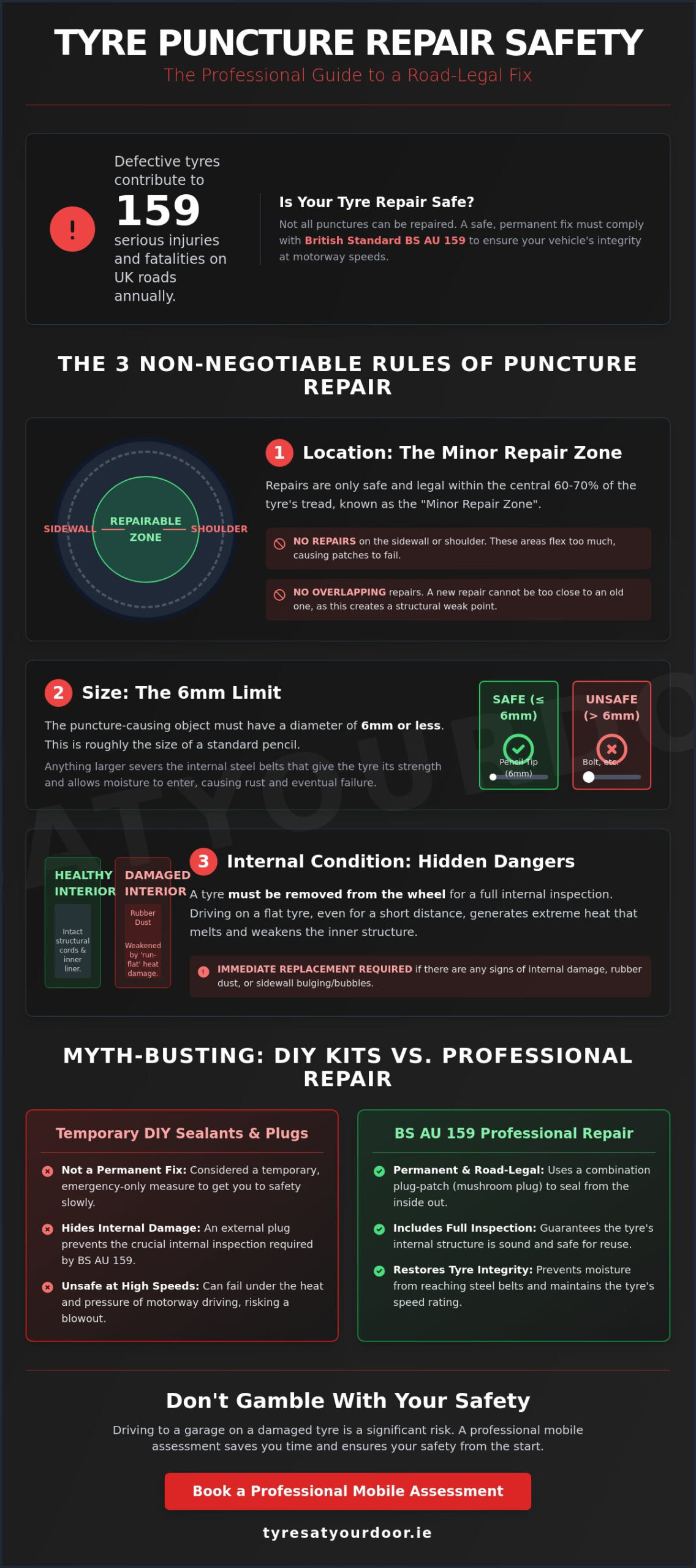
This British Standard sets the bar for what constitutes a legal and safe repair. One of the most critical requirements is that the tyre must be removed from the wheel rim for a thorough internal inspection. You simply cannot see internal damage from the outside. Many “string” plugs or external kits are popular for emergencies, but they are not considered safe or permanent because they don’t allow a technician to check for “run-flat” damage on the inside of the sidewall. A compliant repair uses a combination plug and patch, known as a mushroom plug, which seals the hole from the inside out to prevent moisture from reaching the steel belts. Understanding these limits is the only way to determine if can a puncture be repaired safely without risking a catastrophic failure.
Safety First: Why a Puncture is More Than a Hole
Tyres are complex components designed to carry heavy loads at high speeds. Proper Tire maintenance is essential because even a small hole disrupts the tyre’s ability to manage heat. When pressure drops, the sidewalls flex excessively, generating friction that can reach temperatures high enough to melt the internal rubber compounds. This process leads to structural fatigue, which is the progressive breakdown of the tyre’s internal cords and rubber layers due to repeated stress and overheating. This damage often ruins the tyre’s speed rating and load index, making it a ticking time bomb regardless of how much tread is left. Once the internal structure is weakened, no amount of glue can make it safe again.
The 3 Non-Negotiable Rules of Puncture Repair Safety
Safety isn’t a matter of opinion or a “best guess” by a mechanic. It’s a strict science governed by the physical limits of rubber and steel. To decide if can a puncture be repaired safely, we look at three specific factors that dictate whether a tyre remains roadworthy or becomes a liability. If a tyre fails even one of these criteria, the risk of a high-speed blowout becomes too great to ignore.
The Minor Repair Zone: Where Can We Fix It?
The location of the damage is the most significant factor in repairability. Professional standards dictate that repairs are only permissible within the “Minor Repair Zone,” which is the central 60-70% of the tyre’s tread area. We cannot repair punctures in the shoulder or sidewall because these areas undergo the most flex and stress during cornering and braking. A patch applied to these high-flex zones will eventually peel away or fail. Additionally, we cannot repair a puncture if it is too close to a previous fix; repairs must never overlap, as this creates a structural weak point that compromises the tyre’s integrity.
Size Matters: Why 6mm is the Magic Number
The diameter of the puncture hole must not exceed 6mm. To put that in perspective, 6mm is roughly the diameter of a standard lead pencil. If the object that pierced your tyre is larger than this, it has likely severed too many of the internal steel belts that give the tyre its shape and strength. According to the U.S. Tire Manufacturers Association standards, holes larger than this signify catastrophic damage that a simple plug-patch cannot resolve. Furthermore, a large opening allows moisture to seep into the tyre’s structure, which eventually causes the internal steel wires to rust and perish, leading to a total failure of the tread.
The third rule involves the internal condition of the tyre. Once we remove the tyre from the rim, we look for “mottling” (dark, discoloured patches on the inner liner) or the presence of rubber crumbs. These “crumbs” are essentially ground-up rubber from the inner sidewall, a clear sign the tyre was driven on whilst flat. This damage is irreversible. If you’ve discovered a nail whilst parked at home, a professional mobile puncture repair assessment is the best way to determine if these rules are met before you risk driving to a garage. Finally, run-flat tyres often have different rules; because their reinforced sidewalls can hide internal damage after a puncture, many manufacturers recommend a full replacement to ensure absolute safety.
Myth-Busting: Why DIY Kits and Sealants Aren’t Permanent Fixes
It’s tempting to reach for a quick-fix kit when you’re stuck on the hard shoulder. You want a solution that’s fast and cheap. However, these DIY methods often lead to a false sense of security. When you ask can a puncture be repaired safely using a canister of sealant or a string plug, the professional answer is almost always a resounding no. These tools are designed to get you to a safe location, not to keep you on the road for another six months.
Many drivers believe that if a tyre holds air, it’s safe to drive on. This is a dangerous misconception. Pressure is not the same as structural strength. A tyre might look perfectly fine on the outside whilst the internal cords are disintegrating. Similarly, tyre sealants are often marketed as a permanent fix, but they actually coat the inner liner in a sticky residue. This liquid mess makes it impossible for a professional vulcanised patch to bond later, meaning a repairable tyre ends up in the bin. This substance also coats the rim and can clog the valve, leading to more headaches and higher costs when you finally seek a professional solution.
The “Mushroom” Repair vs. External Plugs
A road-legal repair requires a “mushroom” fix, which combines a plug and a patch in one unit. This method seals the entry path and reinforces the inner liner simultaneously. You cannot perform this from the outside. A technician must remove the tyre from the rim to inspect the internal cavity for hidden damage. External string plugs, often called “bacon strips,” fail because they don’t seal the inner liner, allowing air to seep into the tyre’s carcass. Following NHTSA tyre safety guidelines ensures that every repair maintains the tyre’s original performance standards. Without an internal inspection, nobody can honestly guarantee your safety at motorway speeds.
The Danger of Internal Mottling
The most invisible threat to your vehicle’s stability is internal mottling. This occurs when the inner tyre wall shreds because the tyre was driven whilst under-inflated. The weight of your car crushes the sidewall against itself, creating immense heat. It only takes 100 metres of driving on a flat to ruin a tyre permanently. When we peel a tyre off the rim, we often find “black dust” or rubber crumbs inside. This is the literal skin of your tyre’s interior. If this dust is present, the tyre is dead. This internal check is the only way to answer the question: can a puncture be repaired safely? If the structural rubber has turned to powder, the tyre is a ticking time bomb and must be replaced immediately.
Sometimes, the damage to your vehicle’s rubber is simply too severe to warrant a fix. Whilst we always aim to save you the expense of a replacement, your safety remains the non-negotiable priority. Knowing when to walk away from a damaged tyre is just as important as knowing how to fix one. Certain signs indicate that the structural integrity is gone, meaning the answer to can a puncture be repaired safely is a firm no.
Sidewall and Shoulder Damage
The sidewall acts as the backbone of your tyre. It supports the vehicle’s entire weight and absorbs constant stress from the road. Because this area is designed to flex, a vulcanised patch will never stay bonded to it for long. If you spot a “bubble” or a bulge, this is a clear signal that the internal carcass has failed. The air is only being held in by the thin outer layer of rubber, creating a high-risk situation for a blowout. Even minor “kerbing” damage can hide deep structural tears that compromise the tyre’s ability to stay together at motorway speeds.
Tread Depth and Existing Repairs
We must also consider the tyre’s overall life expectancy and legal standing. In the UK and Ireland, the legal minimum tread depth is 1.6mm. If your tyre is already at or near this limit, a repair is a poor investment and potentially illegal. You can check your tread depth easily by placing a 20p coin (or a €1 coin in Ireland) into the main grooves. If you can see the outer rim of the coin, your tread is too low.
Age is another silent killer. Rubber perishes over time, leading to “dry rot” or fine cracks. Brittle rubber won’t hold a repair plug safely, regardless of how much tread is left. When assessing if can a puncture be repaired safely, we also look at the number of previous fixes. For high-performance tyres, we generally only permit a single repair throughout the tyre’s lifetime. Should your tyre reach the end of its safe service life, we can provide new tyres fitted at your location to get you back on the road. Finally, any sign of exposed steel cords or damage to the tyre bead means the tyre is an instant safety failure and must be scrapped.
Professional Mobile Puncture Repair in Dublin and Wicklow
Driving to a garage with a flat or under-inflated tyre is one of the most common mistakes a motorist can make. As we’ve explored, even a short journey can lead to internal mottling and structural fatigue that ruins an otherwise repairable tyre. This is why a mobile service isn’t just about convenience; it’s a critical safety choice. When you call Tyres at your door, we bring the expertise of a full-service centre directly to your location. We take the stress out of the situation by answering the vital question: can a puncture be repaired safely? By assessing the damage on-site, we prevent further risk to your vehicle’s integrity and your personal safety.
The Tyres at your door Safety Protocol
Every call-out we attend follows a rigorous 5-point safety check to ensure your vehicle remains roadworthy. We don’t just plug a hole and leave. Our technicians perform a visual external inspection, a full internal cavity check for rubber crumbs, and precise measurements of the puncture diameter. We also verify the location within the Minor Repair Zone and ensure your tread depth is above the legal 1.6mm limit. We only use high-grade vulcanising materials that create a permanent, molecular bond with the tyre rubber. If our assessment reveals that a repair would be unsafe, we don’t take chances. We’ll explain the specific failure points and provide an immediate solution, such as fitting a new tyre from our mobile stock, so you’re never left stranded.
Serving Dublin and Wicklow: We Come to You
You shouldn’t have to put your day on hold because of a stray nail. Our mobile units are designed to provide a seamless solution whether you are at home, at the office, or stuck by the roadside. We provide 24/7 emergency assistance across the region, ensuring that a professional technician is always within reach. Our service covers a wide area, including the busy streets of Dublin City Centre and coastal towns like Bray and Greystones. For a comprehensive overview of what to check before and after any tyre incident, our tyre help Dublin safety checklist for motorists is an essential resource to keep you informed and prepared. We pride ourselves on a brisk, purposeful response that moves you from a state of concern to total relief in the shortest time possible.
Our commitment to British and Irish safety standards means you can drive away with absolute peace of mind. We handle the technical diagnostics and the heavy lifting whilst you continue with your day. Don’t risk a dangerous blowout or the high cost of avoidable damage by driving on a compromised tyre. If you’re stuck, Book your emergency puncture repair in Dublin or Wicklow now and let our expert heroes get you back on the road with precision and care.
Stay Safe on the Roads of Dublin and Wicklow
Your safety on the road depends on the hidden integrity of your tyres. We have seen that a safe repair isn’t just about plugging a hole; it requires strict adherence to British Standard BS AU 159. This means verifying that the damage is within the central Minor Repair Zone and ensuring the puncture diameter is 6mm or less. Most importantly, it requires a professional to examine the inside of the tyre to rule out structural fatigue or “run-flat” damage.
Ultimately, the answer to whether can a puncture be repaired safely depends on that critical internal assessment. Driving even a short distance on a flat tyre can turn a simple repair into a mandatory replacement. Our expert technicians serve Dublin and Wicklow with fully equipped mobile tyre units, providing 24/7 emergency roadside assistance at your home, workplace, or by the road. We take the guesswork out of tyre maintenance so you can get back to your day with total confidence. If you are unsure whether your tyre is legally safe or a total write-off, our tyre help Dublin ultimate safety checklist gives you the step-by-step guidance you need before making any decision.
Get your puncture repaired safely today – Book our mobile service
Trust the experts to keep you moving securely. We are ready to take charge of the situation and deliver a precise solution whenever you need us.
Frequently Asked Questions
How far can I safely drive on a punctured tyre?
You should stop as soon as it is safe to do so. Driving even a short distance on a flat tyre causes the sidewall to collapse and generate extreme heat. This process shreds the internal rubber, creating “black dust” that makes the tyre unrepairable. To ensure your vehicle remains roadworthy, avoid driving to a garage and call a mobile service instead.
Is a sidewall puncture ever repairable?
No, a sidewall puncture is never repairable under any circumstances. The sidewall is the most flexible part of the tyre and is under constant stress. A patch applied here will eventually fail because it cannot handle the repeated flexing. If you have damage in this zone, a full replacement is the only way to ensure your safety on the road.
How much does a professional puncture repair cost in Dublin?
The cost of a puncture repair in the Dublin and Wicklow area depends on several factors. These include the time of the call-out, your specific location, and whether the repair is for a standard or specialised tyre. Whilst we cannot provide a fixed quote here, a professional mobile service provides value by saving you the cost of a recovery vehicle or a ruined wheel rim.
Can run-flat tyres be repaired if they get a nail?
Most manufacturers and technicians advise against repairing run-flat tyres. These tyres are designed to support the car’s weight after a puncture, but this process often causes internal damage that is impossible to see. Even if the hole is small, the structural integrity of the reinforced sidewall may be compromised, making a replacement the safest and most reliable choice.
How long does a mobile puncture repair take?
A professional mobile puncture repair typically takes between 20 and 40 minutes once the technician arrives. This includes the time needed to remove the wheel, perform a full internal safety inspection, and apply a vulcanised mushroom plug. It is a brisk and efficient process designed to get you back to your schedule without the hassle of waiting in a garage waiting room.
What is the maximum size of a puncture that can be fixed?
The maximum diameter for a safe repair is 6mm, which is about the size of a standard lead pencil. If the object that caused the damage is larger than this, it has likely severed too many of the internal steel belts. In these cases, the answer to whether can a puncture be repaired safely is no, as the tyre’s structure is too weak to be trusted.
Is it safe to use a tyre that has been repaired more than once?
You can use a tyre that has been repaired more than once, provided the repairs do not overlap and the tyre isn’t high-performance. For tyres with a ‘V’ speed rating or higher, industry standards usually permit only one repair. For standard tyres, multiple repairs are fine as long as they are spaced out according to the BS AU 159 safety zones.
Why do some garages refuse to repair certain punctures?
Garages refuse repairs when the damage falls outside the strict BS AU 159 safety criteria. This often happens if the puncture is in the shoulder, if the hole is too large, or if there is evidence of run-flat damage. Technicians prioritise your safety and their own liability; they won’t risk a blowout by attempting a repair on a tyre with compromised internal integrity. This is why we always perform a thorough check to determine if can a puncture be repaired safely before starting any work.