
You’re cruising along the M50 when a sudden vibration in the steering wheel makes your heart sink. Is it just a rough patch of road, or are you moments away from being stranded on a dangerous hard shoulder? When you need urgent tyre help Dublin provides plenty of options, but knowing whether your tyre is legally safe or a total write-off is the first step to staying in control. It’s completely normal to feel a sense of dread when a warning light flashes or a tyre wall looks slightly bulged. Nobody wants to face an €80 fine and two penalty points for a defective tyre that they thought was fit for the road.
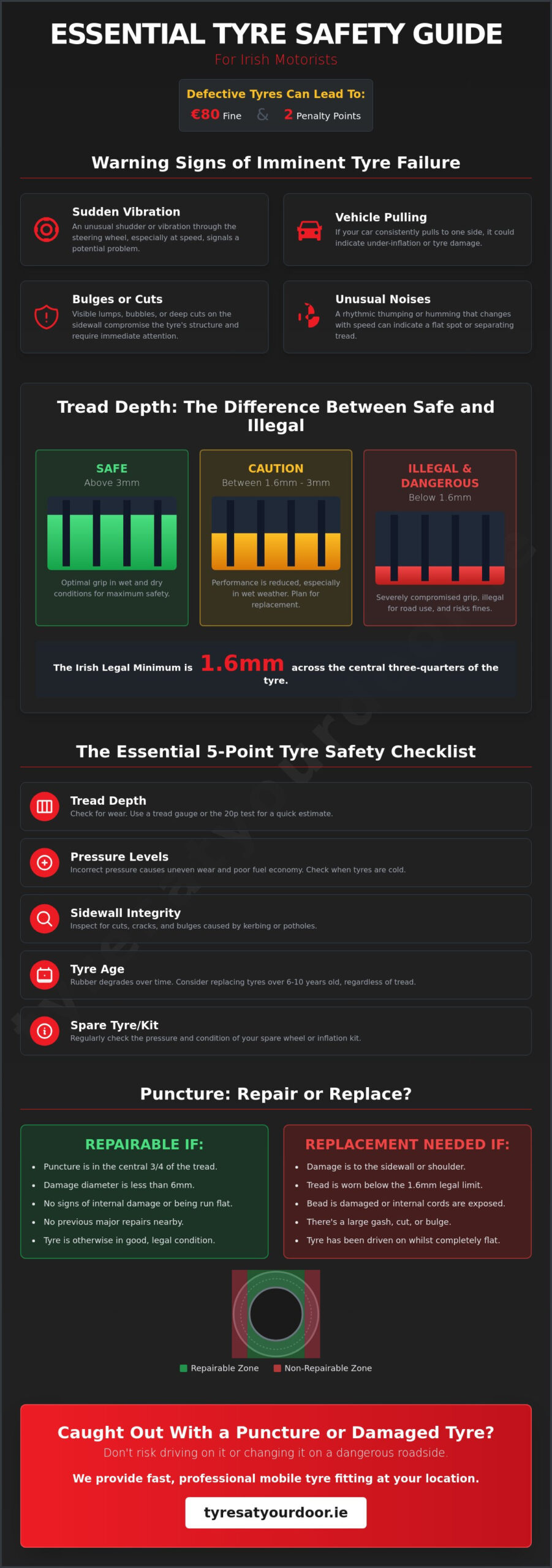
We understand that a puncture never happens at a convenient time. This guide provides a clear safety checklist to help you decide if you can safely drive to a garage or if you require professional mobile assistance. You’ll learn the exact legal requirements for tread depth in Ireland, which remains a strict 1.6mm across the central three-quarters of the tyre. We also explore the limits of puncture repair and explain how to stay safe while waiting for help. By the end of this article, you will have the confidence to make the right call for your safety and your budget.
Key Takeaways
- Identify the warning signs of a critical tyre failure and learn how to remain calm and safe during a roadside emergency.
- Master the essential safety checks, including the 1.6mm legal tread limit, to ensure your vehicle remains road-legal and safe in wet conditions.
- Clarify the strict rules of puncture repair to understand why certain damages require an immediate replacement rather than a simple plug.
- Evaluate the benefits of mobile assistance to see why expert tyre help Dublin is often the most efficient solution for a stranded motorist.
- Implement a proactive maintenance habit to shield your wheels from the impact of local potholes and improve your overall fuel efficiency.
Immediate Assessment: When to Seek Urgent Tyre Help in Dublin
A sudden drop in tyre pressure or the sharp “pop” of a blowout can trigger instant panic. It’s vital to stay calm because your next few decisions determine your safety. A critical failure, such as a complete blowout or a shredded sidewall, requires an immediate stop. Conversely, a slow leak might give you enough time to reach a safe parking area. In the high-pressure environment of Dublin’s commuter routes, the psychological stress of a breakdown often leads motorists to take unnecessary risks. You might feel pressured to “limp” the car home, but this often turns a simple repair into a costly wheel replacement.
If you’re on the M50 or a busy arterial road like the N11, the danger is magnified by high-speed traffic and narrow hard shoulders. Attempting a DIY tyre change in these conditions is incredibly hazardous. Your safety is more important than the time lost waiting for a professional. Expert tyre help Dublin services are equipped with high-visibility markings and the correct gear to handle these situations safely while you remain in a secure location. Never trade your physical safety for the sake of a quick fix on a busy carriage.
Spotting the Warning Signs of Imminent Failure
Identifying a problem before it becomes a catastrophe is part of essential tyre maintenance. Watch for visual cues like unusual bulges or deep cuts that reveal the internal cords. You might also hear a rhythmic thumping or a strange humming sound that changes with your speed. If the car starts pulling hard to one side or the steering feels heavy and sluggish, your tyre’s structural integrity is likely compromised. These performance cues are your car’s way of telling you that a critical failure is close. Don’t ignore these warnings; they are the final signals before a total breakdown occurs. If you’re unsure whether what you’re seeing constitutes a danger, our detailed breakdown of is my tyre safe to drive on covers every warning sign Dublin motorists need to recognise.
The ‘Stop and Check’ Rule for Dublin Drivers
Finding a safe spot amongst heavy city traffic can be difficult, but you must prioritise a flat, stable surface away from moving vehicles. Once stopped, perform a quick 60-second visual scan of all four tyres. Look for nails, glass, or any visible deflation. If the tyre is completely flat or the sidewall is damaged, do not attempt to drive further. This is the moment to call for professional tyre help Dublin. Driving on a rim doesn’t just destroy the tyre; it can cause expensive damage to your wheels and suspension components. Relying on a mobile expert ensures the job is done correctly without putting your life at risk on a busy road.
The Essential Tyre Safety Checklist for Dublin Motorists
Maintaining your vehicle shouldn’t be a guessing game. Performing regular tyre safety checks can prevent a minor issue from becoming a roadside emergency on the M50. Use this structured approach to verify your car’s roadworthiness before you set off. A few minutes of inspection can save you from the stress of a breakdown and the cost of unexpected repairs.
- Check 1: Tread Depth. Ensure you meet the Irish legal minimum of 1.6mm across the central three-quarters of the tyre.
- Check 2: Pressure Levels. Under-inflated tyres increase rolling resistance. This acts as a silent killer of your fuel economy and causes uneven wear.
- Check 3: Sidewall Integrity. Dublin’s tight city-centre streets often lead to “kerbing.” Look closely for nicks, tears, or unusual bulges. Understanding whether tyre sidewall damage repair is even a viable option can save you from making a dangerous mistake on the road.
- Check 4: Age and Perishing. Rubber degrades over time. Tyres over six years old require an expert review, whilst those over ten years should be replaced regardless of their tread depth.
- Check 5: The Spare Tyre. Check the pressure and condition of your spare wheel or inflation kit. It’s useless if it’s flat when you actually need it.
If you discover a bulge or a deep cut during your inspection, it’s best to seek professional tyre help Dublin motorists can rely on. You can easily book a mobile puncture repair or replacement to resolve the issue at your home or workplace without the risk of driving on a compromised tyre.
The 20p Test vs. Professional Tread Gauges
While a tread depth gauge is the most accurate tool, a 20p coin offers a quick estimate. If the outer rim of the coin is visible when inserted into the groove, you’re likely below 3mm. Whilst the law in Ireland allows for 1.6mm, the Road Safety Authority (RSA) strongly advises replacing tyres at 3mm. This is a vital safety margin. Research shows that wet-weather braking distance can increase by 30-50% as tread wears down from 3mm to the legal limit. In a rainy city like Dublin, that extra distance is often the difference between a safe stop and a collision.
Inspecting for Hidden Damage
Don’t just look at the outside of the wheel. Turn your steering to full lock to inspect the inside sidewall, which is prone to damage from Dublin’s deeper potholes. Look for “perished” rubber, which appears as small, spider-web cracks in the surface. This dry rot compromises the tyre’s structure and can lead to sudden blowouts at motorway speeds. Also, check for “flat spots” caused by emergency braking or long-term parking. These spots cause vibrations that can eventually damage your wheel bearings and suspension components.
Puncture Repair vs. Full Replacement: Knowing the Limits
Discovering a nail in your tread doesn’t always mean you need a brand-new tyre. However, safety must always dictate the final decision. Professional tyre help Dublin experts follow strict protocols to determine if a repair is viable. The “Minor Repair Area” is generally defined as the central 60% to 70% of the tyre’s breadth. If the damage is located outside this zone, specifically towards the shoulder or the sidewall, a repair is physically impossible. The sidewall sustains the most flex and load while you drive. A plug or patch in this area will eventually fail, often leading to a dangerous blowout at high speeds. If you’ve recently kerbed your wheel or struck a pothole, it’s worth reading our full guide on tyre sidewall damage repair and the safety risks involved before deciding on your next step.
Run-flat tyres present a unique challenge for Dublin motorists. While they are designed to keep you moving after a pressure loss, the internal structure often suffers irreparable heat damage during that “run-flat” period. Most manufacturers advise against repairing these because the internal integrity is compromised. Similarly, if you’ve driven even a short distance on a standard flat tyre, the internal liner will likely be shredded. A technician will inspect the inside of the casing for “creasing” or rubber dust. If these signs are present, the tyre is a write-off. Adhering to NSAI tyre safety standards is non-negotiable for passing your NCT and ensuring your car handles correctly in wet conditions.
BS AU 159 Standards and Your Safety
Professional repairs must meet BS AU 159 standards. This involves a multi-step process: removing the tyre from the rim, cleaning the wound, and applying a vulcanised plug-patch. A simple “string plug” inserted from the outside is only a temporary measure. It doesn’t meet the safety criteria for motorway driving. Understanding the limits of Can a puncture be repaired safely? is essential for every motorist. Our technicians refuse to repair tyres that show signs of structural fatigue or previous poor-quality patches because we prioritise your long-term road safety over a temporary saving.
Choosing Between New and Part-Worn Tyres
When a replacement is necessary, you might weigh up the cost of new versus part-worn tyres. Part-worn options can be budget-friendly for city driving, provided they carry the “Part-Worn” stamp and meet legal tread requirements. However, for high-mileage commuters using the M50 daily, new tyres are usually a superior investment. They offer the full lifespan of the rubber and guaranteed structural integrity. This provides peace of mind that a second-hand tyre simply cannot match, especially when navigating Dublin’s unpredictable weather and road surfaces.
Navigating Roadside Assistance: Why Mobile Help Beats the Garage
Being stranded on the M50 or M1 with a shredded tyre is a high-pressure situation that requires a swift, professional resolution. Traditionally, your only option was to call a tow truck and have your vehicle hauled to a static garage. This logistical nightmare involves double the waiting time: first for the recovery vehicle and then for the garage to fit you into their schedule. Mobile tyre help Dublin motorists choose instead bypasses these delays by bringing a fully equipped workshop directly to your location. This approach keeps you in the comfort of your own car whilst the work is carried out, saving you from the hassle of coordinating a vehicle recovery.
Safety is the primary concern when working on a busy motorway. Professional mobile units are specifically designed for roadside operations. They use high-intensity LED lighting and strategic vehicle positioning to create a protective barrier between the technician and passing traffic. This level of preparation is something a standard recovery service might lack. When you are stuck on a narrow hard shoulder, you need a team that understands the specific risks of Irish motorways and has the equipment to manage them effectively. Many mobile services in the Dublin area operate outside standard office hours, so it is always worth checking current availability to ensure you aren’t left waiting overnight.
Lost Key? The Locking Wheel Nut Dilemma
One of the most common hurdles in an emergency tyre change is a missing or damaged locking wheel nut key. If you cannot find this specialist tool, a standard roadside wheel change becomes impossible. Many motorists discover the key is missing only at the moment of crisis, which can lead to significant delays. We use specialist equipment to perform locking wheel nut removal Dublin drivers can trust to be damage-free. These tools allow us to remove even the most stubborn security bolts without harming your expensive alloy wheels, a service that many general roadside patrols simply cannot provide.
Emergency Jumpstarts and Roadside Diagnostics
Sometimes, what looks like a tyre-related vibration or a slow-speed handling issue is actually a symptom of a different mechanical fault. Modern vehicles are complex. A dashboard warning light might signal a tyre pressure issue, but it could also indicate a computer sensor failure or a battery that is struggling to hold its charge. Tyres at your door (Off the Rim) provides more than just rubber; we offer a Computer Diagnostic service and a Jumpstart Service to cover multiple breakdown scenarios. This versatility means a single call-out can resolve several issues at once. If your car won’t start after you’ve inspected your tyres, you don’t need a second company to help. You can request mobile tyre repair and diagnostics to get back on the road with minimal fuss. This all-in-one capability turns a stressful breakdown into a manageable, professional repair experience.
Preventing Future Breakdowns: A Maintenance Routine for Irish Roads
Dublin’s roads are notoriously tough on rubber. Between the deep potholes in the city centre and the aggressive speed bumps in residential areas, your wheel alignment is constantly under fire. Misalignment doesn’t just make the car feel “off”; it causes your tyres to wear down unevenly and much faster than they should. If you’ve recently hit a significant pothole, it is wise to seek professional tyre help Dublin motorists trust to verify your alignment and balancing. Balancing ensures that the weight of the wheel and tyre is distributed evenly around the axle. Without it, you’ll experience vibrations that fatigue the tyre structure and your suspension components over time.
Developing a monthly maintenance habit is the most effective way to prevent a roadside crisis. Check your pressures when the tyres are cold, as heat from driving can give a false reading. Correct inflation ensures the tyre’s footprint meets the road exactly as the manufacturer intended. This simple habit extends the life of your tread and keeps your fuel costs as low as possible. Before embarking on a long trip across Ireland, perhaps down to Kerry or up to Donegal, schedule a professional inspection. Catching small issues like slow leaks or perishing rubber early prevents them from leaving you stranded in a remote area far from help.
The Impact of Driving Style on Tyre Longevity
Your behaviour behind the wheel directly impacts your wallet. Aggressive cornering in heavy Dublin traffic puts immense pressure on the outer shoulders of your front tyres. To combat this, consider rotating your tyres every 8,000 to 10,000 kilometres. Moving the front tyres to the rear helps achieve even wear across all four wheels. This ensures you don’t have to replace a single pair prematurely. Proper inflation remains the easiest way to save on fuel; even a slight drop in pressure increases rolling resistance and forces your engine to work harder.
Preparing for the Dublin Winter
The Irish climate is notoriously unpredictable. Whilst we rarely see heavy snow in Dublin, the combination of grease, rain, and morning frost makes for treacherous driving conditions. Check your grip and traction levels as the temperature drops. Many local drivers find that all-season tyres provide the best balance for our temperate but wet climate. As a final safety measure, keep the Tyres at your door contact number in your glovebox or saved in your phone. Knowing exactly who to call for tyre help Dublin wide provides a level of reassurance that makes every journey more comfortable, regardless of the weather.
Stay Safe and Road-Legal on Every Dublin Journey
Your tyres are the only point of contact between your car and the road, making their condition non-negotiable for your safety. By sticking to the 1.6mm legal tread limit and performing monthly pressure checks, you can significantly reduce the risk of a sudden blowout or an expensive NCT failure. Remember that most roadside issues, from missing locking wheel nut keys to sidewall damage, don’t have to end in a stressful tow to a garage. Choosing a mobile service allows you to resolve these problems where you stand, keeping you out of harm’s way on busy motorways.
If you find yourself facing a flat or a damaged wheel, don’t take unnecessary risks. We provide a 24/7 Emergency Response across both Wicklow and Dublin, using fully equipped mobile units to get you moving again quickly. When you need professional tyre help Dublin motorists can rely on, we are ready to take charge and deliver results with precision and care.
Get 24/7 Tyre Help in Dublin Now and drive with the confidence that expert assistance is always just a phone call away.
Frequently Asked Questions
How much does a mobile tyre call-out cost in Dublin?
Call-out charges vary based on your specific location and the time of day you require assistance. Industry rates in Dublin typically fluctuate depending on the urgency of the situation and the distance our mobile unit must travel. We always provide a clear quote before we dispatch a technician to your location. Factors like peak traffic periods or late-night emergencies will influence the final cost of the service.
Can you fix a puncture at my home or workplace?
Yes, we can perform a professional puncture repair at any location where it is safe to work on the vehicle. Our mobile units are fully equipped with the same high-standard tools found in a static garage. Whether you are parked in your driveway or at your office car park, we can assess the damage and apply a permanent, vulcanised repair on-site to get you back on the road.
What should I do if I have a flat tyre on the M50?
Pull over to the hard shoulder as safely as possible and immediately activate your hazard lights. Exit the vehicle through the passenger door and wait behind the crash barrier if one is available. Never attempt to change a tyre yourself on a motorway. Contact a provider for tyre help Dublin motorists trust to handle high-speed roadside rescues with the correct safety equipment and high-visibility markings.
Do you provide emergency help in County Wicklow as well as Dublin?
Yes, our mobile service area covers the entirety of Dublin and County Wicklow. We understand that a breakdown on a rural Wicklow road can be just as stressful as a motorway puncture. Our vans are strategically positioned to reach motorists in Bray, Greystones, and surrounding areas quickly. This ensures you receive a prompt response regardless of which side of the county border you are currently on.
Can you remove a locking wheel nut if I have lost the key?
We use specialist, non-destructive removal tools to extract locking nuts when the original key is missing or the bolt head is damaged. This service allows us to proceed with a tyre change or repair that would otherwise be impossible at the roadside. Our technicians are trained to remove these security bolts without causing any harm to your alloy wheels, saving you a costly trip to a main dealer.
How long does it typically take for a mobile tyre van to arrive?
Arrival times depend on current traffic conditions and the proximity of our nearest technician to your location. In most cases, we aim to be with you within 30 to 90 minutes of your call. Dublin traffic can be unpredictable, particularly during rush hour, but we always provide an estimated time of arrival when you book. This helps you stay informed and safe whilst you wait for assistance.
Is it safe to drive to a garage with a slow puncture?
Driving on a tyre with low pressure is hazardous and can cause permanent structural damage to the internal casing. If you notice the pressure dropping, it is best to stop as soon as possible. Even a slow leak can lead to a sudden blowout if the tyre overheats during transit. It is significantly safer to request tyre help Dublin services to come to you rather than risking a total failure. For a full breakdown of what makes a tyre roadworthy or dangerous, read our complete guide on is my tyre safe to drive on before making any decision to continue driving.
Do you supply both new and part-worn tyres for roadside replacement?
Yes, we carry a versatile stock of both new and part-worn tyres in our mobile units to suit different budgets and needs. New tyres provide the maximum lifespan and safety for motorway commuters. However, we also offer high-quality part-worn tyres that meet all Irish safety standards for a more cost-effective immediate fix. Our technician will help you choose the best option for your vehicle during the call-out.