
You’re navigating a tight Dublin street when a sudden thud against the kerb makes your heart sink. You pull over, inspect the wheel, and spot a small bulge or a jagged cut on the side of your tyre. It’s a frustrating moment, especially when you start worrying about the cost of a replacement or the terrifying risk of a high-speed blowout. You’re likely wondering if a quick tyre sidewall damage repair is a viable option to save your budget and keep your NCT appointment on track.
We understand the stress of facing an unexpected mechanical issue. It’s natural to hope for a simple patch, but the reality of tyre physics is often less forgiving. In this guide, you’ll learn how to identify dangerous structural damage, understand exactly why sidewall repairs are almost never a safe or legal option, and discover the most reliable solutions for Dublin motorists. We will examine the specific NCT criteria that could lead to a “dangerous failure” result and show you how to resolve the problem efficiently so you can get back on the road with total confidence.
Key Takeaways
- Understand why the sidewall is the most critical part of your tyre’s structure and how minor kerb damage can lead to a sudden blowout.
- Discover why professional tyre sidewall damage repair is rarely possible due to the constant flexing of the tyre’s vertical walls whilst driving.
- Learn the specific NCT standards that classify sidewall bulges or exposed cords as an automatic “Fail Refusal,” making your vehicle unroadworthy.
- Identify the immediate safety steps you must take if you notice a change in your tyre’s shape to protect yourself and other road users.
- Explore convenient mobile solutions for a professional tyre replacement at your home or roadside across Dublin and Wicklow.
What is Tyre Sidewall Damage and How Does It Happen?
The tyre sidewall is the vertical section of rubber that bridges the gap between the tread and the rim centre. It performs several vital roles, acting as a flexible shock absorber for Dublin’s bumpy roads and maintaining the tyre’s overall structural integrity. Sidewall damage is defined as any structural or aesthetic compromise to the tyre’s vertical surface. Whilst it might seem like a mere protective barrier, it actually shields the internal cords that keep your vehicle stable and upright under load.
In Dublin, motorists frequently encounter hazards that threaten this sensitive area. Clipping high granite kerbs whilst parking or hitting deep potholes during the winter months are the most common culprits. Driving with under-inflated tyres also puts immense pressure on the sidewall. Without sufficient air pressure, the rubber is forced to bend beyond its designed limits, causing the internal components to rub together and weaken.
Common Types of Sidewall Imperfections
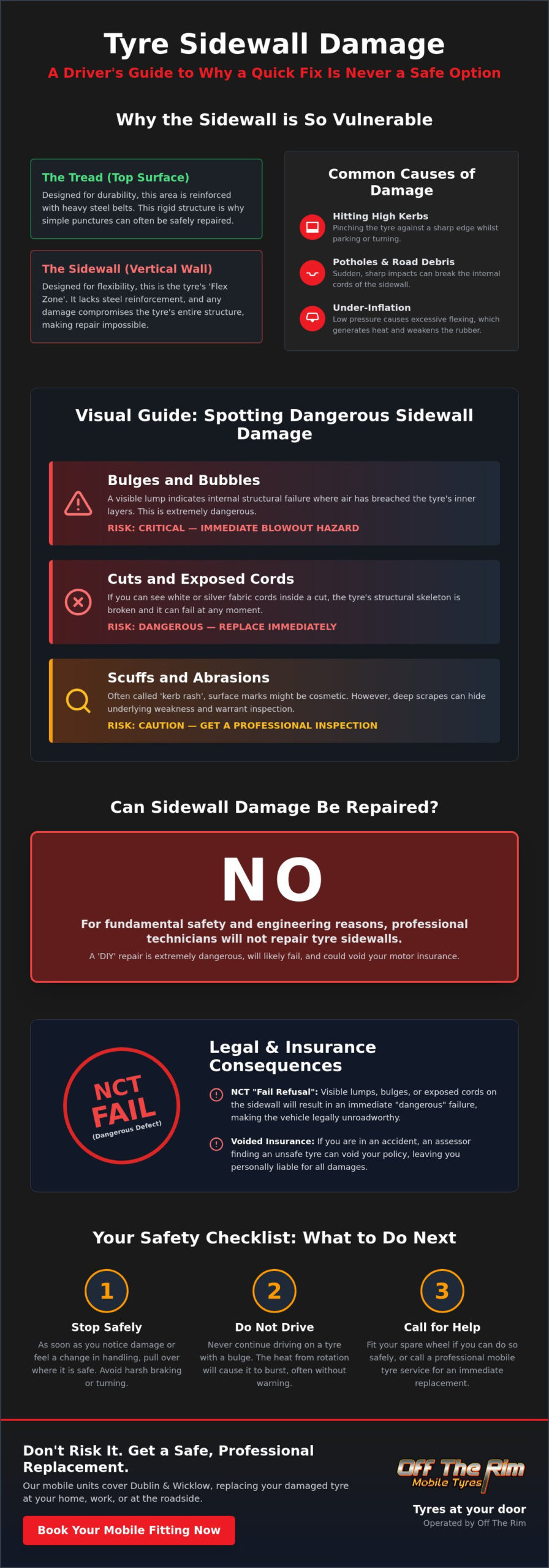
- Bulges and Bubbles: These indicate a critical internal structural failure. When the inner lining is pinched or torn, air pressure pushes through the carcass to create a visible lump on the outside.
- Cuts and Nicks: Slicing from sharp debris, glass, or jagged kerb edges can penetrate the outer rubber. If you can see white or silver cords inside the cut, the tyre is immediately dangerous and prone to a blowout.
- Scuffs and Abrasions: This is often referred to as “kerb rash”. Surface-level marks might be purely cosmetic, but they often require a professional eye to ensure the underlying structure hasn’t been compromised.
Why the Sidewall is More Vulnerable Than the Tread
Understanding Tire construction and safety is essential for every driver. Unlike the tread area, which is reinforced with heavy steel belts to withstand punctures, the sidewall relies on flexible fabric plys for its strength. This design is necessary to allow the tyre to absorb impacts and provide a comfortable ride, but it makes the area much softer and easier to damage than the thick, steel-reinforced tread.
This section is known as the ‘Flex Zone’. It undergoes constant bending and stretching during every single wheel rotation. When you drive at motorway speeds, those sidewalls are moving thousands of times per minute. Any damage in this high-movement area leads to rapid heat buildup. Because the sidewall is thin, it can’t dissipate heat as effectively as the tread. This is why a small nick can quickly turn into a catastrophic failure. It’s also the primary reason why a professional tyre sidewall damage repair is rarely an option; unlike other forms of specialized damage restoration where experts like The Solution can repair complex surfaces, the structural integrity of tyre plys cannot be safely restored once they are severed or stretched.
Can Tyre Sidewall Damage Be Repaired Safely?
The short answer is a definitive no. Whilst we always aim to save our customers money by fixing a puncture where possible, a professional tyre technician will almost never attempt a tyre sidewall damage repair. This isn’t because we want to sell you a new tyre; it’s a matter of fundamental engineering and road safety. Once the vertical wall is compromised, the tyre’s ability to hold the vehicle’s weight is gone.
Standard puncture repairs work by using a vulcanising patch or plug to seal a hole in the tread. This works because the tread is a flat, stable surface reinforced by steel belts. The sidewall, however, is the “flex zone” of the tyre. It undergoes massive deformation every time the wheel rotates. If you apply a patch to this area, the constant bending and stretching will quickly cause the adhesive to fail. The patch will simply peel away, leading to a sudden and catastrophic loss of air pressure whilst you’re driving. For a detailed breakdown of what can be saved, see our ultimate guide to tyre safety and repair limits.
The Danger of ‘DIY’ Sidewall Kits
You might find “universal” repair kits online that claim to fix any part of a tyre. Avoid these at all costs for sidewall issues. Using string plugs or rubber glue on a cut sidewall is incredibly dangerous. Unlike a slow leak in the tread, a failed sidewall repair usually results in an explosive blowout. This happens because the internal fabric cords, which act as the tyre’s skeleton, have been severed. No amount of glue can knit those structural fibres back together. There are also serious legal and financial risks to consider. In Ireland, driving on a tyre with an unsafe repair can void your motor insurance policy. If you’re involved in an accident and an assessor finds a DIY plug in your sidewall, you could be left personally liable for all damages.
Exceptions: When Is a Scuff Just a Scuff?
Not every mark on your tyre means it’s destined for the recycling centre. Purely cosmetic damage, often called “kerb rash,” occurs when the very outer layer of rubber is grazed. If you can’t see any white or silver threads (the internal cords), the tyre might still be safe. Use the “fingernail test”: if the cut is deep enough that you can peel the rubber back with your nail, it’s likely structural. For modern low-profile tyres, any nick deeper than 1mm is a cause for immediate concern. Knowing when to replace a punctured tyre versus when a repair is sufficient can save you both money and risk on the road. If you’re unsure about a mark, it’s always best to get a professional opinion before heading out on the motorway.
Irish Road Law and NCT Standards for Sidewall Damage
Many Irish motorists mistakenly look toward UK MOT guidelines when researching vehicle safety, but Ireland’s Road Safety Authority (RSA) maintains its own rigorous protocols. Under the National Car Test (NCT) system, sidewall damage is rarely treated as a minor issue. In fact, most instances of structural compromise are classified as a “Dangerous Failure.” This means the car is legally unroadworthy and, according to official standards, should not be driven away from the test centre until the issue is rectified.
If you’re searching for a tyre sidewall damage repair specifically to pass your upcoming test, it’s vital to understand the inspector’s perspective. The NCT manual states that any visible bulge, tear, or cord exposure results in an automatic “Fail Refusal.” Once your vehicle fails, you have a strict 30-day window to complete repairs and return for a retest. A retest that requires test lane equipment currently costs approximately €28, whilst minor visual checks are free. However, the stakes are higher than just a retest fee; driving without a valid NCT certificate carries a Fixed Charge Notice of €160 and 5 penalty points.
NCT Failure Points for Tyres
- Bulges or ‘eggs’: Any protrusion on the tyre wall indicates internal carcass failure and is a guaranteed fail.
- Cuts reaching the ply: If a cut is deep enough to expose the internal fabric or metal cords, the tyre is deemed unsafe.
- Incorrect orientation: Tyres with “Outside” markings facing inwards are rejected, especially if they show signs of sidewall abrasion.
- Tyre Age: As of 2026, tyres over 6 years old receive a “Pass Advisory.” Whilst not an automatic fail, it signals that the rubber may be losing the elasticity required to handle sidewall stress.
Your Legal Responsibility as a Dublin Motorist
Operating a vehicle in Dublin involves navigating tight parking spaces and high granite kerbs, both of which are leading causes of sidewall trauma. As a driver, you hold a legal duty of care to your passengers and other road users. Claiming you were unaware of a bulge or a deep cut is not a valid legal defence. Gardaí have the authority to inspect your vehicle at any time, and the penalties for “dangerously defective” tyres are significant. On-the-spot fines typically range from €80 to €120 per tyre, and you can receive between 2 and 4 penalty points on your licence.
Prevention is always more cost-effective than enforcement. We recommend performing a visual inspection at least once a month using a professional safety checklist. Pay close attention to the inner sidewall, as damage there is often hidden from a casual glance. If you spot a defect, don’t risk a motorway journey. A blowout caused by a known defect can invalidate your insurance policy, leaving you personally liable for damages. Addressing a tyre sidewall damage repair concern by choosing a professional replacement is the only way to ensure you remain both safe and legal on Irish roads.
What to Do If You Spot Sidewall Damage
Discovering a bulge or a deep cut whilst you’re out on the road is a high-pressure situation. Your priority must be safety. Stop the vehicle as soon as it’s safe to do so. Avoid any further high-speed driving immediately. High speeds generate heat, and as we’ve established, heat is the primary enemy of a compromised sidewall. Once stopped, perform a visual inspection. Look for any exposed white fabric or silver wires. If you see these, the tyre’s internal skeleton is broken. Even if the tyre looks mostly normal, a change in its circular shape or a visible “egg” on the side means you shouldn’t drive another mile.
Assessing the Severity: Red Flags
Some signs are more urgent than others. If you hear a distinct hissing sound, you’re experiencing an active pressure loss from a sidewall cut. The tyre is currently failing. Another major warning sign is a new vibration felt through the steering wheel or the car’s floor. This often indicates that the internal plys have shifted or snapped, causing the tyre to become “out of round.” If you see visible metal or fabric cords, the tyre is no longer holding the car’s weight safely. In these scenarios, a tyre sidewall damage repair is impossible, and attempting to “limp” the car home is a risk not worth taking. Understanding the key signs of when to replace a punctured tyre rather than repair it can help you make the right call quickly in these stressful moments.
The ‘Mobile First’ Strategy
Whilst some generic advice suggests driving slowly to the nearest garage, this is often dangerous in Dublin’s heavy traffic. Constant stop-start movement and friction build up heat quickly. A damaged sidewall that feels “fine” at 20km/h can suddenly disintegrate without warning. This is why a “mobile first” approach is the safest and most efficient choice. Instead of risking a blowout on the M50 or a busy city street, stay where you are. It’s far better to have the solution come to you than to risk your safety on a defective wheel.
Having a professional technician come to your home or workplace removes the hazard of driving on a dangerous tyre. It also saves you the stress of waiting in a garage queue. Before you call, locate the tyre size on the sidewall (e.g., 205/55 R16) so the mobile unit arrives with the correct replacement. If you need immediate assistance with a replacement or want an expert to check if a scuff is safe, book our mobile tyre service to get back on the road safely. We bring the tyre centre to your driveway, ensuring your safety is never compromised by a risky journey.
Safe and Professional Replacement with Tyres at Your Door
When you’re faced with a bulging tyre or a deep sidewall cut, the priority shifts from diagnosis to resolution. We provide a comprehensive mobile tyre repair in Dublin and Wicklow to ensure you never have to take a gamble on a damaged wheel. Our service is designed to remove the stress of vehicle maintenance by bringing the expertise of a traditional tyre centre directly to your location. Whether you’re stuck at home, in a workplace car park, or at the side of a busy road, we arrive ready to secure your vehicle’s safety.
Our technicians act as your “reliable expert heroes” on the road. We understand that an unexpected tyre replacement is often an annoyance and a financial burden. That’s why we always start with a professional assessment. If your tyre has a minor surface scuff that doesn’t reach the internal cords, we’ll be honest and tell you it’s safe to continue. However, if a tyre sidewall damage repair is impossible due to structural failure, we offer a wide range of new tyres and part-worn tyres to suit any budget or vehicle type.
Why Choose Our Mobile Service?
The biggest advantage of our mobile model is the elimination of risk. You don’t have to worry about a blowout whilst navigating Dublin’s traffic or search for a garage that isn’t fully booked. Our vans are mobile workshops, fully equipped with the latest technology for on-site mounting, balancing, and pressure checks. We serve every corner of County Dublin and Wicklow, maintaining rapid response times so your day isn’t derailed by a kerb-side mishap. By choosing us, you’re opting for a premium service that prioritises precision and care without the need for a tow truck.
Booking Your Emergency Replacement
We’ve made the booking process as modern and efficient as our repair units. You can reach us via a simple phone call or a quick WhatsApp message to share your location and tyre size. We believe in total transparency, which means you’ll receive clear pricing with no hidden roadside call-out surprises before we even set off. If you’ve spotted a dangerous bulge or a deep cut, don’t wait for the situation to get worse. Contact Tyres at your door now for 24/7 mobile tyre assistance and let our experts take charge of the situation. We’ll get you back on the road with a safe, roadworthy tyre in no time.
Stay Safe and Road-Legal with Expert Support
Don’t let a kerb-side mishap turn into a motorway disaster. The sidewall acts as the backbone of your tyre; once that structure is compromised by a bulge or deep cut, the risk of an explosive blowout becomes a matter of “when” rather than “if.” Whilst it’s tempting to look for a quick tyre sidewall damage repair, the physics of tyre flex and strict NCT safety standards mean that a professional replacement is the only responsible path forward. Protecting your passengers and staying road-legal shouldn’t be a source of stress or uncertainty.
Our expert technicians provide 24/7 emergency roadside assistance across Dublin and Wicklow, ensuring you receive an NCT-compliant tyre fitting on-site without the danger of driving to a garage. We offer a range of new and part-worn options to get you moving again quickly, safely, and within your budget. Book Your Emergency Mobile Tyre Replacement in Dublin today and enjoy the peace of mind that comes with a professional, mobile service. Take charge of your safety and get back on the road with total confidence.
Frequently Asked Questions
Is a scuffed tyre an automatic NCT failure?
A minor surface scuff is not an automatic failure if the damage is purely cosmetic. If the rubber is grazed but no internal cords are visible and there is no bulge, the inspector may issue a “Pass Advisory” instead. However, if the scuff is deep enough to reach the structural plys or if it has caused the tyre’s shape to change, it will result in a “Dangerous Failure” and your car will be deemed unroadworthy.
Can I drive on a tyre with a small bulge if I stay under 50km/h?
No, you should never drive on a tyre with a bulge, regardless of your speed. A bulge, often called an “egg,” indicates that the internal carcass of the tyre has failed and air is pushing against the outer rubber. Even at low speeds, hitting a minor pothole or a small stone can cause the weakened area to rupture instantly. This creates a high risk of a sudden blowout that could lead to a loss of control.
How deep does a cut have to be before the tyre is illegal?
A tyre is considered illegal in Ireland if a cut is deep enough to expose the internal fabric or metal cords. Any damage that reaches the carcass compromises the structural integrity of the wheel. If you can see anything other than black rubber inside a cut, the tyre is dangerously defective. Driving with such damage can result in on-the-spot fines of up to €120 and several penalty points on your licence.
Why is sidewall repair more expensive or difficult than tread repair?
The main reason is that a professional tyre sidewall damage repair is rarely possible or safe to perform. Unlike the tread, which is reinforced with steel belts, the sidewall is designed to be flexible to absorb road shocks. Standard patches cannot withstand the constant bending and stretching of the sidewall whilst you drive. Because the structural plys cannot be safely knit back together, a full replacement is almost always the only legal solution.
What happens if my tyre sidewall blows out while driving?
A sidewall blowout causes an immediate and explosive loss of air pressure, which usually results in the vehicle pulling violently to one side. You will feel a heavy vibration and a sudden loss of steering precision. If this happens, don’t slam on the brakes. Instead, grip the steering wheel firmly, maintain your lane, and allow the car to slow down naturally before steering safely to the hard shoulder or a flat area.
Can kerb damage be hidden on the inside of the tyre?
Yes, it is very common for impact damage to occur on the inner sidewall where it’s hidden from a casual glance. Hitting a pothole or a kerb can pinch the inner lining, causing a bulge to form on the side of the tyre facing the car’s chassis. This is why we recommend a full visual inspection of both sides of your tyres at least once a month. If you feel a new vibration whilst driving, it’s a sign that internal damage may be present.
Does insurance cover tyre sidewall damage from potholes?
Most standard motor insurance policies in Ireland do not cover tyre damage unless it occurs as part of a larger accident. Tyres are generally viewed as “wear and tear” items. However, if your tyre was damaged by a specific, known pothole, you may be able to seek compensation from the local city or county council. You’ll need clear photos of the pothole, the damage, and a professional report from a technician to support your claim.
How long does a mobile tyre replacement take at my home?
A professional mobile tyre replacement typically takes between 30 and 45 minutes per tyre once the technician arrives. Our fully equipped vans allow us to perform the entire process on your driveway, including mounting the new tyre, fitting a new valve, and electronic balancing. This “mobile first” approach is much faster than driving to a traditional garage and waiting in a queue, and it removes the risk of driving on a compromised tyre sidewall damage repair candidate.