
You’re heading out for the morning commute when you spot that dreaded sight: a nail buried deep in your tread and a tyre that’s rapidly losing air. It’s an instant source of stress that leaves you wondering exactly when to replace a punctured tyre or if you can get away with a simple, low-cost patch. We understand the anxiety of feeling like you might be overcharged at a garage, or the safety concerns of driving on a repair that might not hold.
While many punctures are fixable, British Standard BS AU 159 sets very clear limits on what constitutes a safe, legal repair versus a mandatory replacement. You shouldn’t have to guess when it comes to the only part of your vehicle that actually touches the road. Our goal is to provide the expert clarity you need to make an informed decision right from your own driveway, ensuring your vehicle remains safe and roadworthy.
This guide breaks down the five definitive signs that a repair is no longer an option. We’ll explain the specific zones of a tyre that can be saved and the types of damage that mean a new tyre is the only responsible choice, so you can get back on the move with total confidence.
Key Takeaways
- Learn how to identify the “Minor Repair Zone” to see if your puncture is eligible for a safe, professional fix.
- Understand the BS AU159 safety standards that dictate exactly when to replace a punctured tyre for legal and safety reasons.
- Identify the critical signs of internal structural failure that occur when a tyre has been driven on whilst flat.
- Compare the value of a professional puncture repair against new or part-worn tyres to ensure you choose the most cost-effective solution.
- Discover why a mobile assessment at your home or workplace is the safest way to handle a flat without risking further damage.
Identifying the Damage: Is Your Tyre Actually Punctured?
A puncture occurs when the integrity of your tyre’s carcass is breached, allowing the pressurised air inside to escape. To understand why this happens, it helps to look at modern tire construction, which relies on multiple layers of fabric and steel belts to maintain shape and strength. When a sharp object like a screw, a shard of glass, or a piece of flint pierces these layers, the structural seal is broken. Knowing exactly when to replace a punctured tyre starts with recognising whether the damage is a minor nuisance or a major safety hazard.
A slow puncture is a gradual pressure loss often caused by a small nail or a faulty valve. These are particularly deceptive because the tyre might look perfectly normal at a glance, but the internal pressure is steadily dropping below safe levels. In contrast, a rapid puncture or blowout usually involves a loud bang followed by an immediate loss of steering control. If this happens, you’ll need to pull over instantly to avoid a collision, as the tyre will no longer be able to support the vehicle’s weight.
Common Symptoms of a Punctured Tyre
Sometimes the signs are obvious, but often they’re subtle enough to miss if you aren’t looking for them. You might notice a physical “squat” appearance where the tyre sidewall bulges more than usual against the road. Another telltale sign is a rhythmic ticking sound that increases in frequency with your driving speed. This is usually a nail or stone stuck in the tread hitting the tarmac with every rotation. You should also keep an eye out for visible irregularities like deep cuts in the rubber or unusual bulges, which suggest the internal structure has been compromised.
Slow Punctures vs. Sudden Blowouts
Slow punctures are frequently more dangerous than sudden blowouts because drivers tend to ignore them for too long. You might top up the air every few days and think you’ve solved the problem, but you’re actually weakening the tyre with every mile. Dublin’s notorious potholes and the uneven road surfaces in Wicklow play a significant role in this type of damage. Hitting a deep pothole can pinch the rubber against the wheel rim, causing internal structural failure that doesn’t always show up as an immediate flat.
If you suspect a problem, you can perform a basic visual inspection. Look for the embedded object but never pull it out yourself. The nail or screw acts like a plug; removing it will cause the tyre to deflate completely, potentially leaving you stranded. Instead, seek a professional assessment to determine if a repair is safe or if you’ve reached the point where you must replace the tyre for your own safety.
The Repairable Zone: Understanding BS AU159 Standards
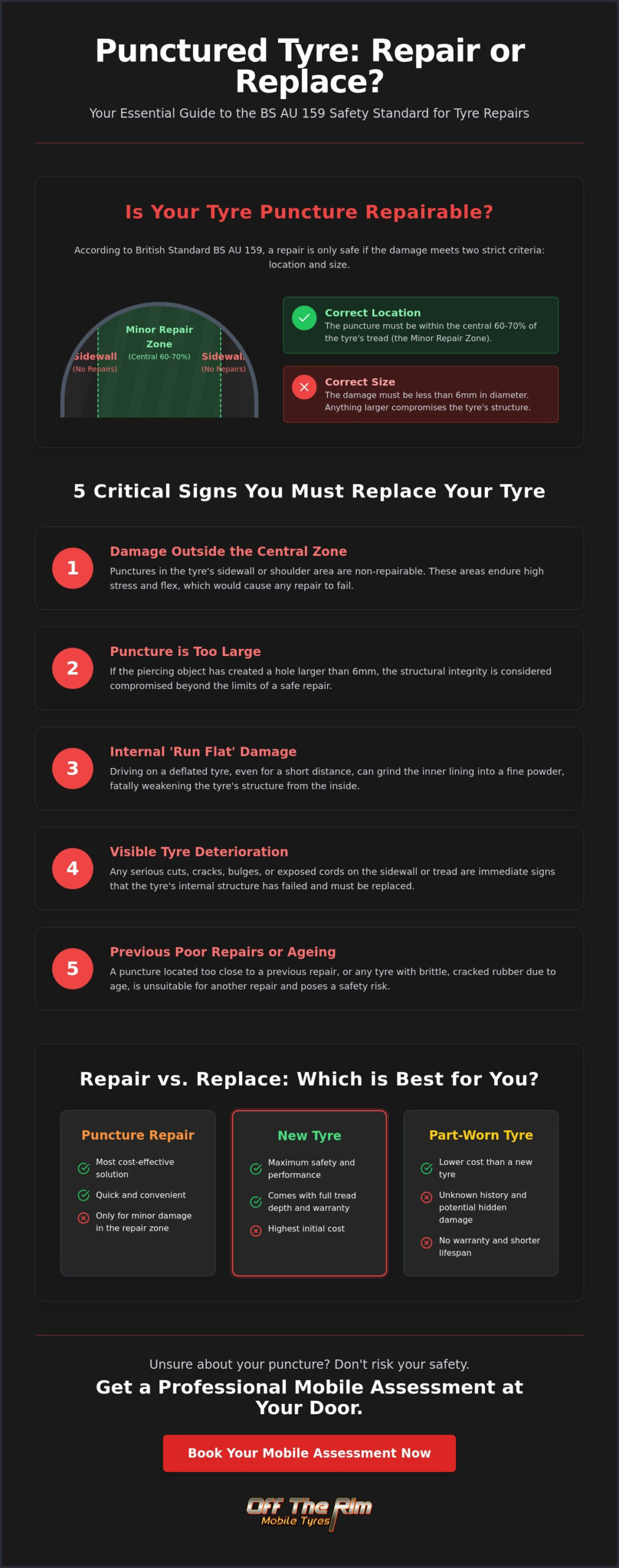
Safety on the road isn’t something to leave to chance. In Ireland, every reputable technician follows the BS AU159 safety standard to determine if a fix is viable. This regulation is non-negotiable because it’s designed to prevent catastrophic blowouts and ensure that any repair can withstand the pressures of daily driving. Deciding exactly when to replace a punctured tyre usually starts with a precise measurement of the damage and its specific location on the tread. If the breach is larger than 6mm in diameter, the structural integrity is compromised. No amount of patching can make that tyre safe for motorway speeds again.
Location is equally critical to your safety. The “shoulder” and sidewall of a tyre are strictly off-limits for any form of repair. These areas endure the highest levels of stress and heat, especially during cornering. Because the rubber flexes significantly in these zones, a patch or plug would simply peel away or fail under the constant movement. If you’ve picked up a nail or screw near the edge of the tread, you’re unfortunately looking at a replacement rather than a repair. It’s a frustrating situation, but driving on a compromised sidewall puts you and your passengers at serious risk.
Where is the Minor Repair Zone?
Think of the “Minor Repair Zone” as the central 60-70% of the tyre’s tread breadth. You can visualise this as a “T” shaped area running down the middle of the tyre. Within this zone, the rubber is supported by robust steel belts that provide a stable, flat foundation for a vulcanised plug to bond with. If the damage sits outside this central strip, the repair won’t hold because the tyre’s natural flex will work the plug loose. For a more detailed breakdown of these boundaries and why they matter, you can read our full guide on can a puncture be repaired safely.
The Importance of an Internal Inspection
You might see “emergency” string plugs sold in motor factor shops, but these are only temporary fixes intended to get you slowly to a service centre. A professional, permanent repair requires removing the tyre from the rim to inspect the internal liner. This step is vital because driving even a short distance on a flat or under-inflated tyre can cause “run-flat” damage. We often call this “munching,” where the metal rim shreds the inner rubber into a fine black powder. Following industry repair standards ensures that these hidden structural failures are identified before they lead to a disaster. If your inner liner is damaged, a Puncture Repair isn’t possible and a new tyre is the only safe option.
5 Critical Signs You Must Replace a Punctured Tyre
Understanding exactly when to replace a punctured tyre is about more than just spotting a nail. It’s about evaluating the entire health of the casing to ensure it can still hold the weight of your vehicle safely. Even if a puncture looks minor, certain “deal-breaker” conditions make a professional repair impossible. If your tyre meets any of the following criteria, it’s time to retire it:
- The puncture is located in the sidewall or the outer “shoulder” of the tread.
- The tyre has been driven on whilst flat, leading to internal structural failure.
- The entry hole is larger than 6mm, which is roughly the diameter of a large bolt.
- The tyre already has an existing repair within the same quadrant of the tread.
- The remaining tread depth is already below the legal minimum of 1.6mm.
Whilst a new tyre represents an unexpected expense, ignoring these signs is a gamble with your safety. A compromised tyre is prone to sudden failure, especially at motorway speeds or under heavy braking.
Sidewall Damage and Bulges
The sidewall is the most vulnerable part of your tyre because it lacks the heavy steel reinforcement found under the tread. This is why tyre sidewall damage repair is both impossible and dangerous. If you notice “bubbles” or bulges in the rubber, it’s usually a sign that the internal carcass has snapped after hitting a sharp kerb in Dublin city centre or a deep pothole on a rural road. If you can see the metal cords or fabric wires showing through a cut in the rubber, the tyre is legally unroadworthy and must be replaced immediately.
Driving on a Flat: The “Run-Flat” Ruin
It only takes about 100 yards of driving on a totally flat tyre to destroy its internal structure beyond repair. When there’s no air to support the vehicle’s weight, the metal rim of your wheel crushes the rubber sidewall against the road. This generates immense heat that “cooks” the rubber from the inside out. You can often spot this by looking for a “dark ring” or a discoloured band around the outer sidewall. Even if the tread looks brand new, heat-perished internals will eventually lead to a blowout. If our technicians find that the inner liner is shredded or shows signs of heat stress, we’ll always recommend a replacement to keep you safe on the road.
Repair, New, or Part-Worn: Choosing the Best Value
If our technician confirms that your damage sits within the central “minor repair zone,” a professional puncture repair is undoubtedly your most cost-effective route. It saves a perfectly good casing from the scrap heap and keeps your bank balance intact. However, once you’ve identified the signs of when to replace a punctured tyre, such as sidewall damage or internal structural failure, you need to decide between a brand new unit or a high-quality part-worn alternative.
New tyres are the gold standard for peace of mind. If you spend a lot of time on the M50, you’ll appreciate the superior wet-weather performance and deeper tread that clears water more efficiently. They offer the longest lifespan, meaning you won’t be searching for a replacement again any time soon. For many drivers, this long-term value outweighs the initial upfront cost, especially when considering the fuel efficiency benefits of modern tread compounds.
This commitment to high-quality equipment is shared by professional hire services like Drive NZ Rental Cars, who maintain their fleet to ensure maximum safety for travellers on the road.
The Case for Part-Worn Tyres in an Emergency
Sometimes an unexpected puncture hits at the worst possible financial moment. This is where part-worn tyres become an excellent emergency alternative. They aren’t just “second-hand” rubber; they are often premium brand tyres with significant tread remaining that have been removed from vehicles for reasons other than wear. To ensure you’re getting a safe deal, look for E-marks, pressure test stamps, and evidence of even wear across the tread breadth. If you’re looking for part worn tyres Wicklow, we provide safety-checked options that meet all legal standards and offer a reliable middle ground for your budget.
Should You Replace Tyres in Pairs?
A common question is whether you need to buy two tyres if only one is punctured. Whilst it’s not a legal requirement, replacing tyres in pairs on the same axle ensures balanced handling and braking. This is particularly crucial for 4WD vehicles, where mismatched tread depths can actually damage the drivetrain or confuse the traction control system. If your budget is tight, a high-quality part-worn tyre can often be matched to the tread depth of your existing good tyre. This provides a balanced solution without the cost of two brand new ones.
If you aren’t sure which path to take, we can help you weigh up the options. You can book a mobile tyre assessment to have a professional look at your damage and recommend the best value solution for your specific vehicle and driving habits.
Professional Mobile Assessment: Solving Punctures at Your Door
Many motorists assume they have to limp their car to the nearest garage when they find a flat. This is a mistake that often costs more than it saves. Driving even a short distance on an under-inflated tyre is the quickest way to ruin the internal structure, turning what could have been a simple fix into a mandatory replacement. Our technicians provide a definitive answer on when to replace a punctured tyre by performing a full on-site inspection, ensuring you don’t take unnecessary risks with your safety or your wallet.
Tyres at your door (Off the Rim) specialises in bringing the tyre centre to you. Whether you’re stuck in your driveway or stranded at your workplace, a mobile assessment is the most efficient way to handle a puncture. It removes the stress of driving on a spare or risking further damage to your wheel rim. Before you set off, it’s a good idea to consult a tyre help Dublin checklist to ensure your vehicle is in a safe condition to move at all.
The Mobile Repair Process
Our mobile service isn’t just a quick patch job. We perform a comprehensive on-site removal and internal inspection to check for the “munching” or heat damage discussed earlier. If the damage meets BS AU159 standards, we apply a permanent, vulcanised patch that restores the tyre’s integrity. If the technician determines that the tyre is non-repairable, don’t worry. Our vans carry an on-board stock of new tyres and part-worn tyres to get you back on the road immediately. We also specialise in damage-free wheel nut removal, so you won’t be stuck if you’ve lost your locking key.
24/7 Emergency Support in Dublin and Wicklow
Punctures don’t stick to office hours. We organise a 24/7 response for motorists across Dublin and Wicklow, covering everything from the busy M50 and N11 to the winding rural roads of the Wicklow Mountains. We understand that a flat tyre is more than an inconvenience; it’s a disruption to your day that requires a fast, professional resolution. Our expert heroes arrive equipped to solve the problem on the spot, providing clear, honest advice on whether a repair or a replacement is the safest path forward. Stuck with a puncture? Book a mobile tyre assessment now and let us bring the solution directly to you.
Get Back on the Road Safely and Swiftly
Tyre safety is a non-negotiable part of responsible driving. You now know that the location of the damage, the size of the puncture, and the hidden internal condition of the rubber are the deciding factors in when to replace a punctured tyre. Whilst a repair is often the most cost-effective solution, your safety must always come first. If you’ve spotted sidewall bulges or have driven on a flat, a replacement is the only legal and secure option to avoid a dangerous blowout.
Don’t risk your safety or your wheel’s integrity by driving to a garage on a failing tyre. Our 24/7 mobile service across Dublin and Wicklow brings the solution directly to your home or workplace. Every van is stocked with new and part-worn tyres; our technicians carry out BS AU159 safety compliant repairs on-site with precision. We take the stress out of the situation so you can get on with your day without the hassle of a recovery truck.
Get your puncture fixed at home or roadside – Book Now
We’re ready to help you get back behind the wheel with total confidence and peace of mind.
Frequently Asked Questions
Can I drive on a punctured tyre for a short distance?
No, you should avoid driving on a flat tyre entirely. Even a few hundred yards can cause the wheel rim to crush the sidewall rubber, leading to internal structural failure that makes the tyre unrepairable. If you’re unsure exactly when to replace a punctured tyre, driving on it usually settles the debate by making a replacement mandatory for your safety.
Is it cheaper to repair or replace a punctured tyre?
A professional repair is significantly cheaper than a replacement. A standard puncture repair typically costs a small fraction of the price of a mid-range or premium new tyre. However, a repair is only an option if the damage is minor and located in the central tread. If the puncture is too large or sits in a dangerous zone, the cost of a new tyre is a necessary investment.
How many times can a single tyre be repaired?
Most tyres can be repaired up to two or three times, provided the punctures are in different quadrants of the tread. Repairs must not overlap, and the tyre’s speed rating can sometimes limit the number of permissible fixes. Every repair must be performed to BS AU 159 standards to ensure the casing remains stable and safe for continued use on the road.
What is the maximum size of a repairable puncture?
The maximum repairable size for a puncture is 6mm in diameter. This is roughly the width of a standard pencil or a large bolt. If the hole is larger than this, the steel belts and fabric cords within the tyre’s construction are too heavily damaged to be safely reinforced with a plug and patch. In these cases, you must fit a new tyre.
Will a puncture repair kit pass an NCT test?
A temporary puncture repair kit or “slime” sealant will not pass an NCT test. These kits are designed as emergency solutions to get you to a service centre only. A professional, vulcanised repair that is applied from the inside of the tyre is perfectly legal and will pass the inspection, provided the tyre meets all other tread and condition requirements.
Can run-flat tyres be repaired after a puncture?
Most manufacturers advise against repairing run-flat tyres. Because these tyres are designed to be driven on whilst flat, it’s almost impossible to tell if the internal structure has been weakened during the period of pressure loss. To maintain the safety standards of your vehicle, replacing a punctured run-flat is usually the only recommended course of action.
How long does a professional puncture repair take?
A professional mobile puncture repair typically takes between 30 and 45 minutes. This includes the time to safely jack up the vehicle, remove the wheel, and perform a thorough internal inspection of the casing. Our technicians work efficiently to ensure you’re back on the move quickly without compromising on the precision or safety of the repair.
Why can’t a puncture in the tyre shoulder be fixed?
Punctures in the tyre shoulder cannot be fixed because this area experiences the most flex and heat during cornering. A repair patch needs a stable, flat surface to bond correctly. The constant movement in the shoulder would cause a patch to peel away or fail, leading to a sudden and dangerous loss of pressure whilst you’re driving.